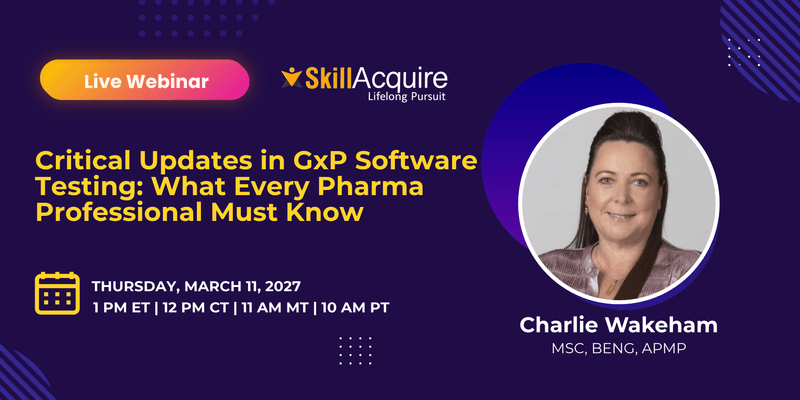
Presenter: Charlie Wakeham, MSc, BEng, APMP
Date: Thursday, March 11, 2027
Time: 1 pm ET | 12 pm CT | 11 am MT | 10 am PT
Duration: 90 minutes
Course Description
The benefits of QRM [Quality Risk Management], as envisaged by ICH Q9, have not yet been fully realized.” This was the statement made in 2020 in ICH’s final concept paper on the revision to Q9 Quality Risk Management (QRM). Despite the introduction of several regulatory guidelines and industry initiatives, the pharmaceutical industry has continued to face challenges in consistently and objectively implementing risk management approaches.
The journey toward risk-based assurance began with the US FDA's Pharmaceutical cGMPs for the 21st Century — A Risk-Based Approach initiative in the early 2000s, followed by ICH Q9 Quality Risk Management in 2005 and FDA CDRH's Case for Quality initiative in the 2010s. These initiatives were driven by the need to improve patient safety, product quality, and data integrity by focusing resources and efforts on areas with the greatest potential impact. The objective was to ensure that the level of effort was commensurate with risk rather than increasing resources and testing activities unnecessarily.
The 2008 ISPE GAMP 5: A Risk-Based Approach to Compliant GxP Computerized Systems provided a pragmatic approach to applying QRM to computerized systems validation (CSV), including software testing. However, traditional risk-based testing within the constraints of scripted testing often resulted in companies testing everything to avoid uncertainty about justifying what was not tested. This created a belt-and-braces approach rather than a truly risk-based testing strategy.
A significant development came with FDA's recognition that all testing contributes to the overall assurance that a system is fit for its intended use. This opened the way for both scripted and unscripted testing to provide documented evidence of assurance. GAMP 5 Second Edition (2022) and FDA's Computer Software Assurance (CSA) guidance (2026) further supported this approach, paving the way for more effective, risk-based assurance.
Presented by Charlie Wakeham, this webinar explores the role of Quality Risk Management within the Pharmaceutical Quality System under ICH Q10 (2008) and examines the synergy between ICH Q9, GAMP 5 Second Edition, and FDA's CSA guidance. Drawing on the 2026 Third Edition of the ISPE GAMP Good Practice Guide on Testing GxP Systems, of which Charlie was a guide leader, the session examines the importance of critical thinking and the different types of software testing approaches available to regulated organizations.
The session also addresses common misconceptions, particularly the assumption that the level of testing formality must correspond directly to the level of risk. Instead, it emphasizes selecting the most effective type of testing to meet specific test objectives. Participants will explore test planning, test scripts, test evidence, test management, deviations, traceability, reporting, and ways to optimize assurance records without creating excessive documentation burdens.
Additionally, the webinar examines how testing performed by suppliers and during earlier internal testing activities can be leveraged, recognizing that all testing contributes to defect detection and demonstrating that a system is fit for its intended use.
Finally, the session explores the role of AI in testing and the assessment of modern electronic testing tools, including AI-augmented digital validation tools. It also addresses effective regression testing and change management approaches in an environment where software release cycles are increasing and upgrades may be
pushed to regulated companies without the option to decline or defer them.
By the end of this webinar, participants will gain practical insights into applying critical thinking, selecting appropriate testing approaches, and implementing effective risk-based assurance throughout the computerized system lifecycle.
Learning Outcomes
- Understand the role of QRM within the Pharmaceutical Quality System.
- Apply ICH Q9 and Q10 principles to computerized systems assurance.
- Understand the evolution of CSV and its alignment with FDA CSA guidance.
- Apply risk-based testing throughout the system lifecycle.
- Differentiate between scripted and unscripted testing approaches.
- Evaluate and leverage supplier and previously performed testing.
- Optimize test documentation, evidence, and traceability.
- Manage testing deviations and reporting effectively.
- Assess AI-enabled testing tools and digital validation solutions.
- Implement effective regression testing and change management strategies.
Areas Covered in the Session
- Drivers for CSV
- Rise of the Risk-Based Approach
- Evolution of CSV and alignment with CSA
- Test Types
- Test Planning
- Test Scripts and Evidence
- Test Management and Deviations
- Traceability and Reporting
- Tool Use
- Testing in the Operational Phase
- Interactive Live Q&A
Recommended Participants
- Computerized System Validation (CSV) Professionals and Specialists
- Quality Assurance (QA) Managers, Directors, and Specialists
- Validation Managers, Leads, and Engineers
- Commissioning and Qualification (C&Q) Engineers and Specialists
- Pharmaceutical Quality Risk Management (QRM) Professionals
- IT Managers, Directors, and GxP IT Professionals
- GxP Computerized System Owners and Administrators
- Software Testing and Quality Engineering Professionals
- Regulatory Compliance and GxP Compliance Professionals
- Digital Validation, Computer Software Assurance (CSA), and Automation Specialists
About the Presenter
Charlie Wakeham has specialized in computerized systems in regulated industries throughout her career. Through her company, Wake Up to Quality, she offers expert consultancy in computerized systems validation, data integrity and governance, and quality management systems.
With more than 25 years of experience in the Life Sciences industry, Charlie has held roles in process engineering, project management, and systems R&D at Pall Life Sciences (now Cytiva) in the UK. She also served as APAC GxP Compliance Manager at Waters Corporation, where she established and managed validation services across the Asia-Pacific region, and as Global Head of Quality and Compliance at Magentus, a SaaS clinical LIMS provider.
Charlie has been a passionate ISPE GAMP® volunteer since the early 2000s and has served on numerous ISPE and GAMP committees. She is the immediate past chair of the GAMP Community of Practice, which has 5,000 members. She founded GAMP UK in 2010 and is also the founder and past chair of the ISPE GAMP South Asia Community of Practice. In addition, she serves as Co-Chair of the GAMP Editorial Review Board, leads the
GAMP CSA Special Interest Group, and is a Director of the ISPE Australasia Affiliate Board.
Charlie has contributed to or led the development of ten GAMP guides, including the Second Edition of GAMP 5 in 2022 and the Third Edition of the GAMP Testing GxP Systems Good Practice Guide in 2026.
Additional Information
After Registration:
You will receive an email with login information and handouts (presentation slides) that you can print and share with all participants at your location.
System Requirement:
- Internet Speed: Preferably above 1 Mbps
- Headset: Any decent headset and microphone which can be used to talk and hear clearly
Can't Listen Live?
No problem. You can get access to an On-Demand webinar. Use it as a training tool at your convenience.
Snippet From Our Previous Session